
In today’s post, I am completing a write-up of my progress with the headroom mods for the LXP reverbs by Lexicon. I am still learning and my blog posts evolve. At this moment, I do not know the answers but I am learning and will update as I find out. As per usual, this is not a guide, it is a blog of my own learning and experimentation.
Okay, so to begin. While I had my Lexicon LXPs open for the battery mod, I thought – lets look around and see what else I can do to improve the overall quality and experience of using the LXPs. I am alreayd aware of the chip replacement and the battery holder mod. Now, I want to look at headroom.
I researched a number of posts but the following was the most interesting and useful: Increase Headroom Lexicon Reverb Input
The TLDR is as follows – you can increase the headroom from -10dB to +4dBU by either removing or changing a resistor in a feedback loop in the input opamp. +4 has the input pot at 1 o’clock.
The front end opamp has too much gain. It’s a 330 ohm gain shunt resistor with a 10k feedback. I change that shunt resistor to 3.9k ohms, that allows about 10 db of gain. Then +4 has the input pot at 1 o’clock.
Jim Williams, post 2
So let’s explore – what does this mean. First thing to note is that the original poster asks about the LXP-1 and LXP-5. From my research, the quote is in relation to the LXP-5.
A schematic is uploaded to post 5 (link). By following the schematic, head to the heading towards the top left stating “Analog Input”. From analogue inputs, follow right until you see the following shape – note values are from the LXP-1:
……….681…..R51/R69
………_______
………|……………………|
……..W………………..\/
………|……….R50/R68
………|……W____
………|……..20K……..|
………|……….…………….|
………|_\ …………….|
.………..| 4570 ________
620……./……………………..|……
………………………………………….|…..
R59/60
What is an Opamp?
The 4570 is the opamp. It has a negative and positive symbol at the front of the opamp and takes to signals, outputting one. An operational amplifier (op-amp), is like a super-sensitive electronic “listener” that compares two signals. They have two inputs, an Inverting Input (–) marked with a minus sign. If you feed a signal here, the op-amp flips it upside down (inverts it). It also has a Non-inverting Input (+) marked with a plus sign. If you feed a signal here, the op-amp keeps it the same way (non-inverted).
So what is a shunt resistor? According to AI:
“A shunt resistor in these Lexicon reverb units is the resistor connected from the inverting input of the op‑amp to ground. It works together with the feedback resistor to set the gain of the input stage. In practice, it’s located right at the front end of the circuit, inside the op‑amp input stage before the level pot, and changing its value directly alters how much the op‑amp amplifies the incoming signal”
From the inverted input, there is a feedback loop and for the LXP-5, in this loop there is a 340ohm (R71 and R74) resistor and a 10K resistor. R71 and R74 are the 340ohms and should be changed to 3.9 kΩ. When reading here (link), for the LXP15 and a slightly different topic, Jim mentions “If you remove the pot you will need to adjust the gain of the first opamp stage. It has a 7.5k feedback resistor and a gain shunt resistor from the inverting input of the opamp to ground. Simply lifting up one leg of that gain shunt resistor will turn the input stage into a closed loop follower with unity gain.”. This says to me that the shunt resistor is in the inverting input and therefore, I think the positions highlighted are correct.
The source of my confusion comes from the quote. R72 and R76 are the 330 ohms resistors entering the positive side (invertining input) of the OpAmp but my thoughts are that this is irrelevent because later on, Jim mentions:
R1/R2 +6db is the formula. 10k feedback with 3.9k shunt is +10db. 20k feedback with 6.8k shunt is the same. Lower resistors are less noise but the DSP is far more. Add a small 22pf feedback cap to lower clock noise leakage. Do the same on the next mixer opamp stage.
So I think 340ohms must be the shunt.
For the LXP-15, this value sholud be 2K (link).
Okay, so lets map this out to what I THINK is correct – it may not be:
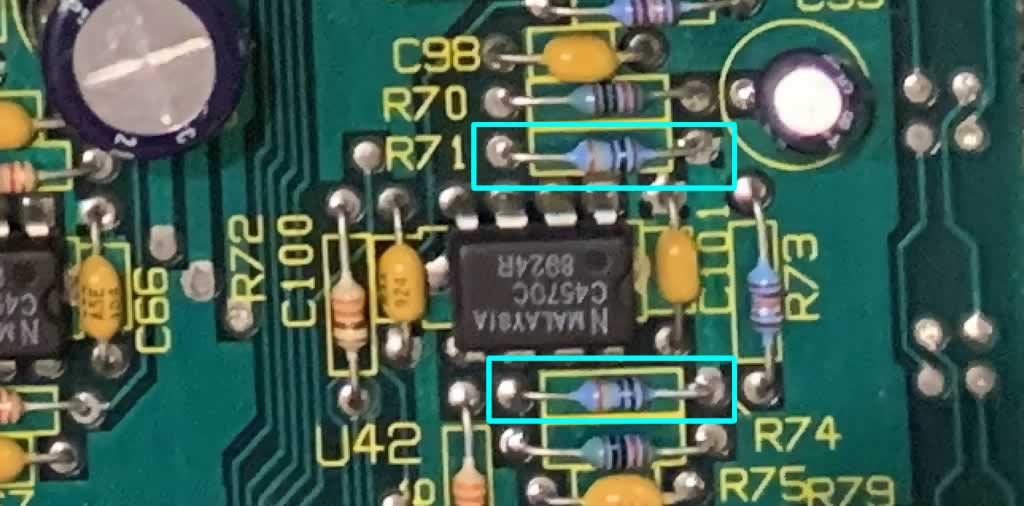
Lexicon LXP-5 Shunt Resistor to 3.9K
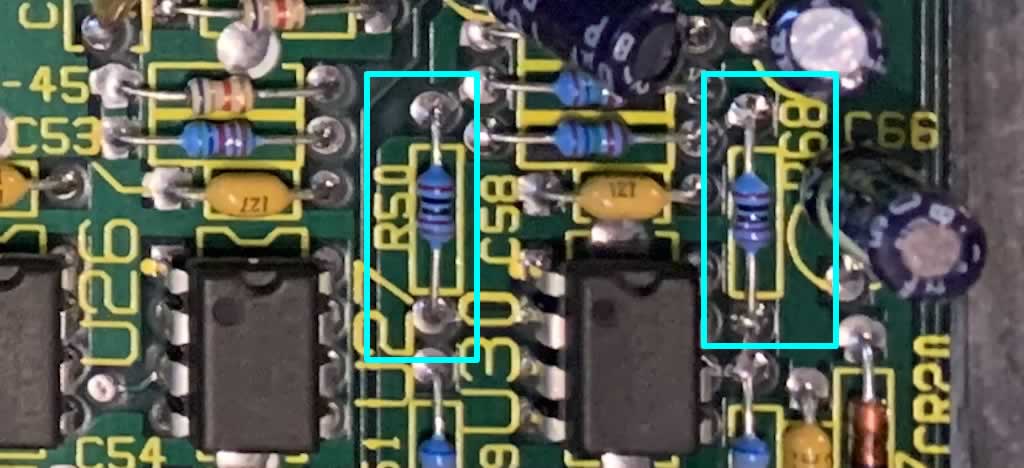
Lexicon LXP-1 to 6.8K – Needs additional 22pf feedback caps and on next stage
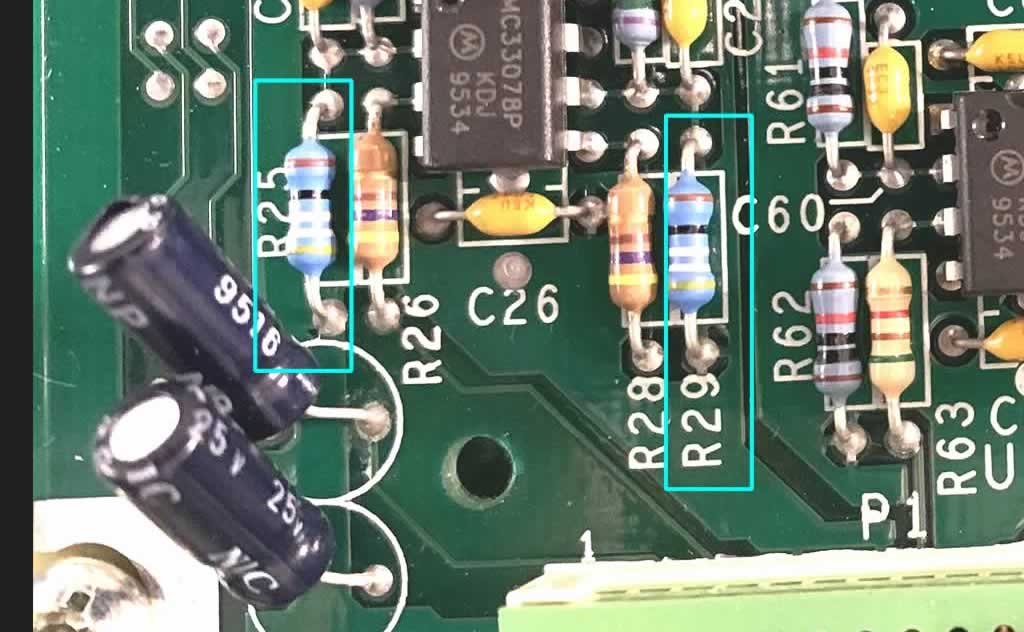
LXP-15ii R25 and R29 to 2K towards othe bottom left of the case.