
After opening my Lexicon LXPs, I realised that the batteries are on their last legs and I need to make an order for battery holders. Research led me to the Adam Tech, BH-76A-1 which is meant to be a good fit for the board. The only problem is that to get them at a decent price, I will need to buy in bulk to get a good shipping rate or combine with other parts.
My conclusion is that it’s best to use this opportunity to see what types of mods are available and buy parts in a bulk order.
To open up an LXP-1, I recorded a video that can be found here:
So here goes, what other types of mods are available for the LXPs. Please note – use with caution, I may have mistyped or misunderstood! I found the following:
Pots:
- Replacing PCM54HP chip to PCM54KP (covered in depth in another post: link)
- Cleaning Pots and Encoders.
- Bypassing bad pots
- Replacing Pots
- Power supply capacitors
- Op-amps
- Headroom Mod
- Reflex RAM solution.
Information about opening and cleaning pots can be found here [link] and encoders [link].
Bypassing bad pots can be found here: [link] and involves 15k and 2.2k resistors. I’ll probably head this route when the pots go because I can control nearly everything through my own editors.
Pot replacement details can be found here [link]. I contacted the company directly to find the part number used in the Lexicon and to see if I could find a modern equivalent. There were modern parts produced for it but they are out of production and hard to track down. I included all of my research, including part numbers, at the end of the blog.
Power supply capacitors:
***************Update – really huge thanks for 211 for getting back to me about the changes. I have added some notes based upon the feedback from 211. Please note that I still may have misinterpretted 211’s comments while shaping the information to the blog. I suspect not as 211’s notes were great but it’s always important to use caution.
From 211 [link] for the LXP-1
- Removed hum: Replaced all 1000uF PSU electrolytics and 7805 (regulator).
The information about the regulator is slim which means I do not know how to replicate it.On the PSU section, there are 3 components which provide regulated voltages: + 12/-12 (U19 and U13) and 5v (U11). 7805 is the component which provides 5V, you can see it easily, near the battery it had a screw and a small metallic piece to dissipate heat on it. If experiencing noise and/or artefacts, worth replacing this component to confirm the PSU is okay. - Additional scratchy noise: spraying contact cleaner (with caution – do not degrade the carbon) in the pots removed the scratchy noises – confirmed that this can yield really good results! Jim also very kindly provided details to potential replacements (details below).
Jim Williams [link] for the LXP-1
- Replace 1000uf caps with 2200 uf 25V Panasonic HD caps, same size as the original 1000 uf. These refer to the C28, C27, C20, C23, C15, C16 1000uf capacitors but you may find that this does not make a difference.
- Add a Pair of 470uf/25V caps on the power lines near the jacks for extra filtering.
I would like to find out more about this and lack information here. Possibly space near the jacks to add 470uf on the output regulated pin of U19 and U13 (pins 3). LXP-1 does not seem to have them, it’s a common practice, look at OUT pins on Figure 3: 7812 Circuit Diagram here (link). You’ll see 100uF polarized caps on this example. Possibly used 470uf/25v, for a very stable PSU.
LXP15: CFCreative (link)
- “All new Nichicon Fine Gold audio capacitors in the audio processing circuitry of my LXP-15. Swapped 22uf for 47uf and no problems.”
- “I can’t remember exactly but if you open the case there is 5 larger capacitors in the power supply then about 25 small ones. https://s1299.photobucket.com/user/E23N42SF/Lexicon%2520LXP15%2520Inside/story replace the coin battery as well at the same time.”
Note – another very kind musician has provided me with a very detailed mod map for the LXP15 which I will write up in the future.
Op-amps
- LXP-1, If I have read this right, 211 was thinking about replacing input opamp U30 with a socket, and try TL072 and OPA2134 but it looks like this would not have much in the way of impact.Although 211 did not complete this, OPA2134 opamps usually work very well and add a lot of clarity in the high frequencies. Potential to make a big difference, for U30 (the input opamp) and U26 the output Opamp. At least the dry signal will not be too degraded. Swapping U24 and U27 could potentially affect the wet signal, but it’s unclear due to the 4053 switches. It is a big desoldering job though to get in those sockets to try out the different opamps : OPA2134, TL072 or NJM5532.
- Jim mentions that the stock signal 33078 opamps are ok and there is no benefit to use high test opamps there as the 16 bit conversion will wash that out.
- Jim recommended opamps: ADA 4625-2, about $11 each for sample and hold to increase quality and resolution but I need to work out what this means and where to do this. I cross referenced another Jim post here: and additional [link]. To understand more, I posted a follow-up question.Looks like Jim has possibly used ADA 4625-2, in place of LF353 (U31) and changed the timing cap (C63) for a polystyrene (styroflex) one. It’s on the output of the DAC, so it will affect the wet sound.The Alex uses the same LF353 but a different capacitor for the timing cap . It’s the only one capacitor of this kind on the Alex PCB. This means Lexicon upgraded something here after the LXP-1 which means it was likely important for the designer to do it.
- 211 replies, I’ll add extra caps … and try small 47pf or 33pf caps in the feedback loops of the amps. This refers to the input opamp U30 and R50 and R68 feedback resistor. It’s recommended to use 18pf as in the Alex
- Jim mentioned replacing the timing caps with polystyrene.
Headroom Mod
A good chunk of information can be found here [link] and [link].
- Jim mentions the front end opamp has too much gain. It’s a 330 ohm gain shunt resistor with a 10k feedback and [link] “The front end opamp has too much gain. It’s a 330 ohm gain shunt resistor with a 10k feedback. I change that shunt resistor to 3.9k ohms, that allows about 10 db of gain. Then +4 has the input pot at 1 o’clock.” I decided to explore in detai it’s own blog post here (link).
Chip Upgrade:
Chip upgrade (various) PCM54HP chips to PCM54KP link] and link]. Eprom Chip Puller needed.
Reflex RAM Problems:
For Reflex RAM chip problems:
Really good video. Very useful about the chip itself. Texas Instruments DV41464P-10. I saw a note in the comments saying that if the part Texas Instruments DV41464P-12 (12ms) is available, use that. If you’re out of luck with a Lexi specialist, it’s worth getting the chip and checking with a local repair company that specialise in soldering.
Reserach: Pot Research and Potential Leads
Update: Thank you Jim, answer to the pot replacement here (link)
In this section, I cover the research completed. Sadly, it did not come to anything viable but thought it worth addin to the bottom of the blog for reference.
I did call Lexicon and they were only able to tell me that the Input (first knob), mix and output (second and third knobs) used the following pots 1 – 10KBX2 and
2 – 50KAX2 but could not tell me which one was the input knob.
Additional information from Modwiggler and a link to this advert: [link] 5 pins straight across? maybe not. A later post here [link] indicates it is different, akin to picture 2. From the service manual [link]. “2 SW,RTY,BSCD 16 POS, 16 position rotary encoders”. LXP 4 Bit encoders and datasheet [link] and mouser listing for manufacturer [link].


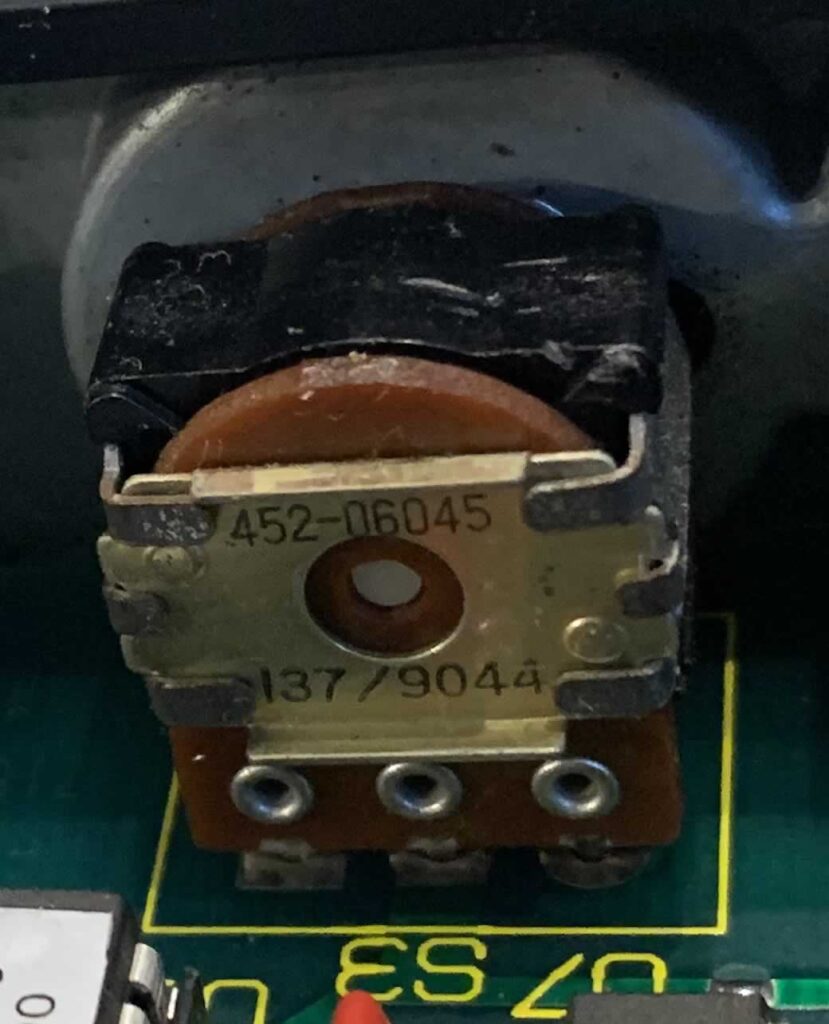
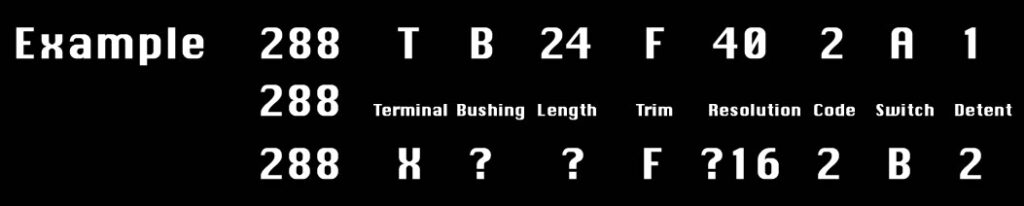
I opened mine up and found the following pots: 452-06045. Searching in Google returned the following: [link] for 2bit encoders and looking up in Digikey returned a great match in datasheet [link]. Okay, so there are several codes. Searching found [link] the original 288 switch is an inverted GRAY-CODE encoder.
From the sheet on Digikey, there are several options:
| 288 | T | B | 24 | F | 40 | 2 | A | 1 |
| – | Termimal | Bushing | Length | Trim | Resolution | Code | Switch | Detent |
| 288 | X | ? | ? | F Flattened | ? My guess is 16 | 2 Gray | B Momentary | 2 16 Detents |
V:\Dept\MK\編輯用舊資料\Modify Folder\最新VR(可編輯檔)\~$288-1 2017.10.11.pdf
Changing the S&H opamps to DA 4625-2 does make a difference because of the slew rate improvement. I’d recommend putting a 0.1UF polystyrene as the cap for the S&H stage as well. I have done this mod myself for the LXP15 and for the PCM70.